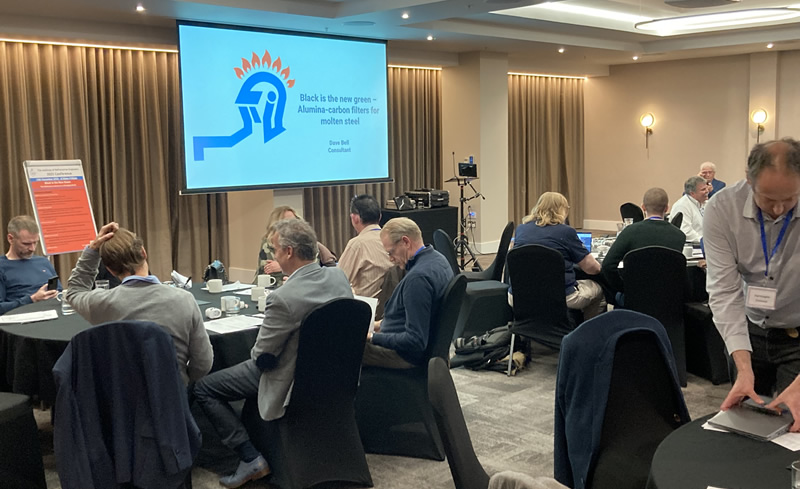
Such was the continued success of the IRE Annual Conference in 2025 that the Institute is considering extending the event into a two-day conference plus one day training day to accommodate all the technical information and offer delegates additional networking opportunities. Outgoing President Mike Lamkin urged IRE members and other delegates to offer suggestions on the matter.
The request followed a day full of high class presentations, discussions and debate on 19 November when the industry came together for the 2025 conference, entitled ‘Black is the New Green – The Refractory Industry in a Changing World’. The subject matter placed sustainability at the centre of the debate, enabling presenters and delegates to engage in detailed deliberation about the challenges and opportunities the sector is facing as it adapts to more ‘green’ methods of manufacture. Held at the central location of the Quays Hotel, Victoria Quays, in Sheffield (UK), the conference attracted high calibre expert speakers, keen to impart their wisdom to the 100+ delegates in attendance.
Green Steel Strategy
Richie Hart of Tata Steel gave a fascinating insight into the company’s ‘Green steel strategy and transition,’ explaining how the use of the highly publicised installation of the electric arc furnace will provide a “path to zero”. He told delegates: “We think it is a flexible piece of equipment.” During an extensive Q&A session, Hart’s colleague Matthew Davies said: “We’re working with refractory companies regarding process design to get more consumption out of the ladles. There are challenges and the way we recycle our plant will have an impact.” He revealed the aspects that refractories companies need to consider: “Cost and consumption of refractories is the wrong metric, what we all need to consider is ladle management and the way casters manage plant – thermal management and asset availability are the most important considerations.”
Sustainable Performance
Florian Ahouanto of Imerys spoke about: ‘Andalusite based refractories: enabling sustainable performance and future applications.’ He argued that andalusite’s “outstanding properties” are derived from it being a reactive mineral, noting thermal shock resistance thanks to thermal expansion, self-healing abilities and crack deviation. He said: “It is a sustainable product and you can play with different densities. The CO2 footprint is quite low compared to usual.”
He pinpointed iron and steel as the main markets, followed by glass, cement, incineration and foundries. However, he warned: “not all andalusites are equivalent.” He gave examples of the work being undertaken by Imerys on the production of bricks with andalusite and plastic clay and concluded: “Andalusite will have an increasing role to play in the future of refractories.”
Dominic Wadkin-Snaith of Lucideon gave a presentation on: ‘Thermal efficiency of precast dryers in refractory shapes manufacturing – a data driven approach.’ He spoke of the AMRICC Centre approach being computer vision. This is undertaken with image capture using multiple cameras. By using an edge detection model – which tracks the edges during firing but loses the edge as it shrinks – images are taken where failed, rotated then augmentation is applied. He explained: “Edge detection models do struggle, but augmentation is the key and we can essentially build a database from these images. You can reduce noise, increase contrast and track diameter of the part during sintering and take it further with a range of infrared cameras. Then we apply computer vision to SEM and microscope images.”
Optimised Design
IRE-AUS President and independent consultant Dave Hollott had made the epic journey from Australia to present at the conference and meet with European members. His presentation was entitled: ‘Fully optimised design of refractory linings.’ Having spent thirty years of his career in maintenance of refractories, Hollott was able to pass on his advice about design and project management. He showed several photographic examples of anchor failures and preventable accidents, plus examples of safety methods which could be applied to keep workers safe.
He said part of the role when working with customers on refractory design is to drill down into exact requirements. “Sometimes the customer is not sure of what they need,” he explained. “It is important to talk to the customer and break up what you need to do. Discuss things that aren’t always considered.” He spoke of the intricacies of working in a contract supply team. “Different people have different objectives,” he said. “Design and supply, installation and commissioning, operation and maintenance. What does the client want? Some only want to get to install and commission.
You have to keep your costs low throughout the cycle, but you have to understand your role. You might only have a small part of the cycle, but you have to consider everything during the design phase, including doing a failure analysis. The latter should be undertaken at the design stage and shared with the client.” He warned: “You must also set acceptance criteria before you start and have all this upfront before the refractory installer moves in.” He went on to highlight examples of projects he had worked on.
High Performance Demands
‘High performance steel ladle refractories for high quality steel production: an overview,’ was the title of one of two presentations given by Suresh Srinivasan of the Materials Processing Institute in the UK (MPI). Giving an overview of the refractory steel ladle, he explained how the refractories’ performance is “very challenging.” He went through the key performance factors for high quality steel production and ladles.
He said that companies needed to “invest in high performance refractories and proactive maintenance” and that “innovation in ladle refractory technology remains essential.” Kicking off the afternoon sessions, independent consultant, David Bell took to the podium to present: ‘Black is the new green – alumina-carbon filters for molten steel.’ He highlighted and compared the different filters on the market – steel, alumina-carbon, 3D printed, ceramic. He said: “Alumina-carbon filters are more resilient during the metal pour. You can’t pour very low carbon steel through them, that is better with zirconia filters. 300m is the largest filter at the moment – can go larger but they have to be handmade, so they won’t fit on the production line.” In concluding, he thanked Vesuvius, his previous employer, for permission to present the paper.
Tyler Warren of Monocon gave a presentation entitled: ‘Innovative alumina in-situ spinel forming green brick for steel ladle applications.’ The premise of the presentation, he explained, was “how to get a green brick for steel ladles.” He said: “This is difficult to do on site as we are dealing with high temperatures, so we use modelling. Brick manufacture is energy intensive and time consuming and there are a lot of carbon emissions from firing the bricks. By not firing, there would be a saving of 500g/t of brick carbon reduction. This is the main benefit, but it entails lots of challenges such as strength, stability issues, on-site cutting and handling. However, all this can be answered with our robust binder.”
He continued: “When firing on site, porosity does go up but not as much as spinel bricks. You lose a little strength when heating, but our bricks don’t drop below 100MPa. Because they expand and work with spinel, they actually close up, so there are no gaps.” He went on to highlight the field trials being undertaken with the bricks to monitor how they perform.
Sebastian Klaus of Almatis spoke on: ‘ECO-TAB @ heat – new insights from steel plant applications.’ He explained how the “target balance is between volume and lining.” Using a Tata Steel case study, Klaus highlighted the benefits of this lower density alumina refractory aggregate, which has been developed for wear linings. He said: “ECO-TAB has a higher porosity so there is increased water demand, but the flow controls and the cold crushing strength are comparable and there is lower thermal conductivity. Despite the higher porosity, the slag resistance is comparable to other aggregates.” He went on to show some industrial trials and highlighted the potential to reduce energy losses, resulting in significant cost savings for users.
‘Infra-red monitoring of glass futures furnace heat-up from ambient air to operating oxy-fuel,’ was presented by Neil Simpson of Simpson Combustion & Energy. He was joined by James Cross of LAND who had brought along an infrared thermo imaging boroscope, explaining that: “we have stayed true to this technology.” Cross said: “In an ideal world we would have one camera that covers all wavelengths. With this technology we can look at a furnace as it heats up. It’s about energy from waste. We can see the mid wavelength in the furnace to give the tube wall temperature and can view the surface of the grate and the tiles above it. We can pinpoint exactly where there is a leak and the hotspots.”
Simpson echoed the enthusiasm. “In the glass industry we always get cyclops when something goes wrong, this camera is 200,000+ cyclops and has 324,000 temperature measurements. With this we can model the entire heat up of the furnace. The bigger the furnace capacity and order book, the greater the payback.”
In his second presentation of the day, Suresh Srinivasan of MPI UK spoke about: ‘Sustainable refractories for green cement production.’ He said: “The cement industry is responsible for eight per cent of global CO2, with the calcination step being a particular culprit making up over half of this. This is the largest of the concrete industry’s problems. There is also, of course, a natural resources issue – if there’s no flagstone, there is no cement.”
He gave an overview of the CO2 emissions statistics and highlighted how the “push towards ‘green’ cement production is transforming the refractories industry.” He gave an insight into the processing conditions in cement kiln, highlighting the challenges and pinpointed refractory failure issues. Utilising case studies with refractories supply companies he showed several solutions for green raw material, claiming: “Technology transition is possible.”
Evening Event
There were plenty of breaks during the day to enable delegates to network and enjoy the IRE hospitality or visit the tabletop displays from sponsoring companies. The event concluded with a dinner in the evening with live musical entertainment from The Bowkers.
The dinner afforded the opportunity for outgoing President Mike Lamkin to hand over the baton, and the presidential chain of office, to newly elected President Dominic Oates. Mike thanked the delegates, the conference sponsors, the wider membership and the corporate partners for their support to enable the IRE to continue to develop. He also thanked the IRE officers and council for their considerable efforts to drive the organisation forward. He showed his appreciation to the journal production team and IRE secretary Georgina Nicol for her hard work and determination in managing the administration of the organisation and in the significant effort taken to organise the conference.
In accepting the chain of office, Dominic Oates said: “I am honoured to be the next President of the Institute of Refractories Engineers and am particularly grateful to Katy Moss and Mike Lamkin for their hard work over recent years to shape the institute into what it is today. We have great potential for future growth and I look forward to working with you all to achieve this.”
Sponsoring Companies
The IRE Annual Conference would not be possible without the contributions from the sponsoring companies – Alkegen, Capital Refractories Ltd, Peter Skinner Minerals Ltd and Velco GmbH – and IRE would like to thank them for their support.
IRE Training Day
- Refractories – Keeping it Together
- Bond Systems for Refractories
The day after the IRE Annual Conference, the institute held an IRE Training Day at the same venue. Topics covered included: sintering; cement bond; resin bond; chemical bonds; additive manufacturing (3D printing) forming methods.
#IRE #Institute #Refractories #Engineers #Journal #Conference #Training